
Hyperbaric Medicine
Hyperbaric Medicine
Natural Healing.
Natural Results.
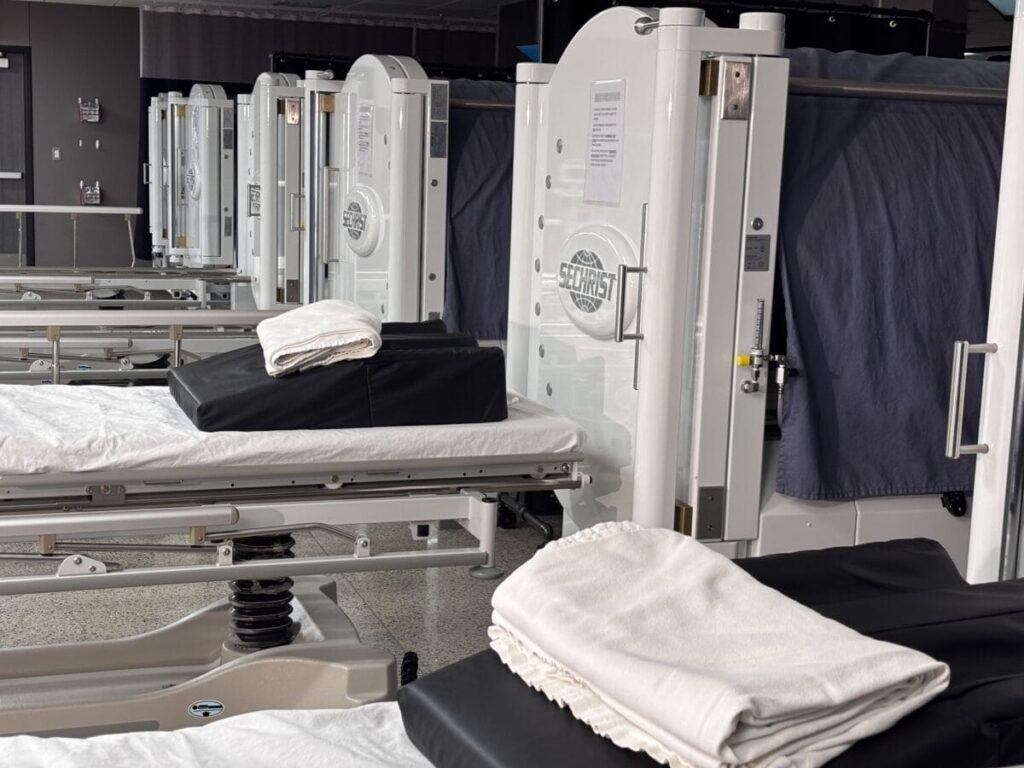
Hyperbaric Medicine is a medical treatment that involves breathing 100% pure oxygen in a pressurized chamber. This increased pressure allows your lungs to absorb significantly more oxygen than under normal conditions, which helps deliver higher levels of oxygen to the body’s tissues. The boost in oxygen supports healing, reduces inflammation, fights infection, and promotes the regeneration of damaged cells. Hyperbaric Medicine is FDA-approved for a variety of conditions and is also used to support recovery, wellness, and athletic performance.
How Can Hyperbaric Medicine Help Me?

Improved Quality of Life
Studies show that regular Hyperbaric Medicine sessions improve cognitive function, reduce stress, and stimulate many types of healing.

Lowers Total Body Inflammation
Hyperbaric Medicine sessions work to reduce inflammation in the body.

Boosts your
Bloodstream
Hyperbaric Medicine can help your blood carry more oxygen and strengthen your white blood cells against infection.

Much More
Stories from Our Patients
Swanson Hyperbarics has helped hundreds of people just like you achieve their wellness potential. From aches and pains to much deeper issues, our services can help boost your health and make you feel like you again.
Bringing out the Best in you with customized Hyperbaric Medicine Plans.
Are you not feeling your best and don’t know why? Are you frustrated with what’s been suggested so far? Are you struggling with reaching your body’s full potential?
We’ve been there and can help you gain the health and strength you hope for by providing you personalized care.
We specialize in leading edge screening tools and treatments that integrate Hyperbaric Medicine, HOCATT™, PEMF, RightEye & qEEG, nutrition and supplements that naturally unlock your body’s potential.

Hyperbaric O2 Therapy

Custom Recovery Plans

PEMF Technology

Veterans Services

Stimulate Your Body's Natural Healing Ability
Call for your consultation today
Our Services have helped numerous people with:
- Air or Gas Embolism
- Carbon Monoxide Poisoning
- Clostridial Myositis and Myonecrosis
- Crush Injuries and Other Acute Traumatic Ischemia
- Decompression Sickness
- Arterial Insufficiencies
- Severe Anemia
- Intracranial Abscess
- Necrotizing Soft Tissue Infections
- Osteomyelitis (Refractory)
- Delayed Radiation Injury (Soft Tissue and Bony Necrosis)
- Compromised Grafts and Flaps
- Acute Thermal Burn Injury
- Idiopathic Sudden Sensorineural Hearing Loss
Healing with Hyperbarics
Find out from some of our patients how Hyperbaric Medicine has helped them heal

Who can benefit from Hyperbaric Medicine?
Supports healing, recovery, and wellness.
Who can benefit from Hyperbaric Medicine?
Suffering from concussion or TBI
Who can benefit from Hyperbaric Medicine?
If you're suffering from chronic pain or inflammation.

Frequently Asked Questions
Being informed is the most important thing when choose a treatment option that works for you. Learn more with our Hyperbaric Medicine FAQs or by contacting one of our Certified Hyperbarics Technicians.
The number and frequency of sessions needed varies with the specific condition that is being treated. Our medical providers will determine each patient’s protocol. Our staff will work with you to schedule your sessions.
A session generally lasts about 1 hour, unless a 90-minute session has been prescribed. Of course, treatments can sometimes take longer, especially if patients have difficulty clearing their ears during the pressurization phase.
There are 14 indications that are approved to be treated by the Hyperbaric Medicine Committee:
- Air or gas embolism – when gas bubbles enter arteries or veins
- Carbon monoxide poisoning – when carbon monoxide is inhaled and injuries arise from that
- Clostridial myositis and myonecrosis – a rapidly progressive infection of the soft tissue, known commonly as “gas gangrene”
- Crush injury, compartment syndrome, and other acute traumatic ischemias – injuries that result from trauma, from minor contusions to limb threatening damage
- Decompression sickness – referred to as the “bends,” is the formation of inert gas bubbles in tissue, usually caused by rapid ascent from a dive.
- Arterial insufficiencies – wounds that are not healing properly
- Severe anemia – a loss of red blood cell mass due to hemorrhage, hemolysis, or aplasia
- Intracranial abscess – an inflammation caused from infected material coming from local or remote infectious sources
- Necrotizing soft tissue infections – a rare but severe type of bacterial infection that can cause tissue death
- Osteomyelitis – an infection of bone or bone marrow
- Delayed radiation injury (soft tissue and bony necrosis) – some radiation treatments leave patients with cell damage to soft tissue (such as mouth, throat, and the gastrointestinal tract).
- Compromised grafts and flaps – when a skin graft does not heal properly
- Acute thermal burn injury – severe burns that can be treated with enhanced oxygen
- Idiopathic sudden sensorineural hearing loss – hearing loss caused by a malfunction in a certain nerve in the brain
The number and frequency of treatments needed varies with the specific condition that is being treated. For many conditions, one treatment a day (Monday through Friday) is given for a total of 20 to 30 treatments, usually a total of four to six weeks.
There are a couple stages during a typical treatment (or dive).
- The first stage is compression (or diving) in which the chamber is pressurized to the prescribed pressure (or depth).
- After the oxygen periods are finished, the chamber is depressurized (or surfaced) and the treatment is finished.
Conditions Treated
There are 14 conditions covered by insurance in the US. These have been approved by the FDA.
- Air or Gas Embolism
- Carbon Monoxide Poisoning
- Chronic Refractory Osteomyelitis
- Acute Traumatic Ischemia (Compartment Syndrome)
- Decompression Sickness
- Diabetic Wounds (with certain criteria)
- Necrotizing Skin Infections
- Gas Gangrene
- Radiation Tissue Injury
- Severe Anemia
- Thermal Burns
- Intracranial Abscess
- Skin Grafts and Flaps
At Swanson Hyperbarics, we mainly treat conditions that are called “investigational” or not covered by insurance.
This does not mean there is no research backing up Hyperbaric Medicine for these conditions.
In other countries, many of these are widely accepted and covered by insurance.
- Acute Pancreatitis
- Anti-Aging
- ACL / MCL Injuries
- Arthritis
- Autism
- Bell’s Palsy
- Cerebral Palsy
- Cancer Adjuvant Therapy
- COVID-19
- Concussions / TBI
- Chronic Regional Pain Syndrome
- Degenerative Disc Disease
- Depression
- Erectile Dysfunction
- Endometriosis
- Fibromyalgia
- Glaucoma
- Headaches (Migraine and Cluster)
- IBD (Crohn’s and Colitis)
- Infertility
- Interstitial Cystitis
- Korsakoff Syndrome
- Lupus
- Lyme Disease
- Macular Degeneration
- Multiple Sclerosis
- Muscle Injury
- Neuropathy
- Parkinson’s
- Pre & Post Surgical Healing
- Epilepsy
- Fetal Alcohol Syndrome