

At Swanson Hyperbarics, we are in the middle of an exciting anti-aging campaign with two different subjects. The campaign follows the study done in Israel in 2020, that measures age markers in subjects before and after a number of hyperbaric oxygen sessions, or dives. Hyperbarics can affect telomeres, a long-known marker of aging.
Before we started with our subjects, Mike and Kari, a friend of Swanson Hyperbarics heard about the study and plans at the clinic. The friend, a 64 year old female, was interested in trying it for herself. The goal is to have longer telomeres after a protocol of forty hyperbaric oxygen dives. Since telomeres shorten as we age, longer telomeres are basically indicative of a ‘younger’ cell. And studies reveal that telomere length can affect the rate of aging and the potential onset of age-related diseases.
The first step in the protocol is a simple blood test that can measure telomeres in white blood cells. This test calculates the average telomere length of these cells. The results show the telomere starting point. Below you can see her initial results.
Blood Test #1-Starting Point:
So what does this graph show? The black line represents average telomere length for different ages. You can see it declines throughout our lives, with a more noticeable decline after the age of 40. Telomere length, on the left, is measured in kilobase (kb) pairs. The higher the telomere score, the “younger” the cells. A number highlighted in green and above the line indicates telomere length is longer than the average expected. A number highlighted in red and below the line would indicate a shorter than expected telomere length.
The first test done by our friend is the green highlighted number. At age 64, the green number above the black line indicates her cells are slightly younger, but close to her chronological age.
After 20 hyperbaric dives, her second blood test showed promising results below!
Blood Test #2-Midway Point:
The results showed that after 20 dives, or halfway through the protocol, her telomeres lengthened by more than 9% to 8.36 kb. If you follow the 8.36 number to the left to where it intersects with the black line, it puts her telomere length equal to that of someone in their upper 30’s, on average.
Finally, to finish her protocol, she completed 20 more hyperbaric dives. After those dives a final blood test showed more promising results which are illustrated below.
Blood Test #3-Final Blood Test:
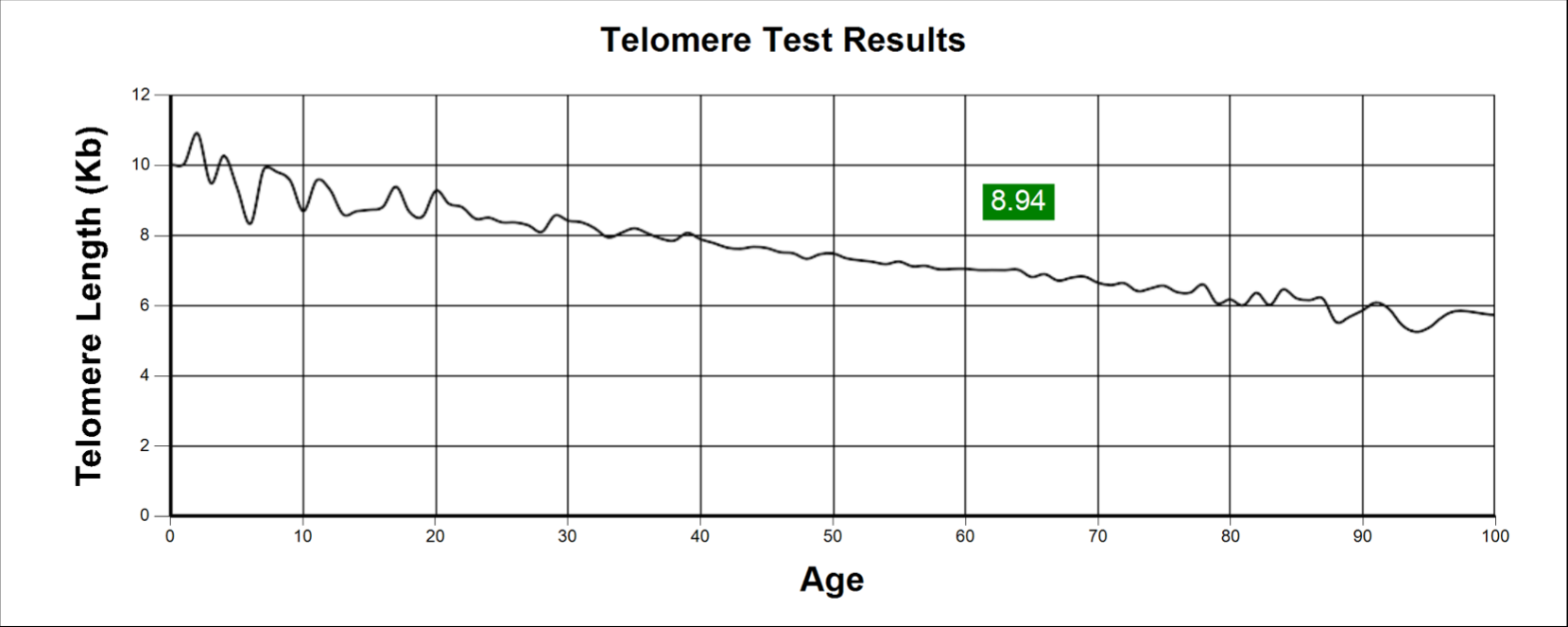 The final test revealed another increase in telomere length of almost 7% to 8.94 kb. Again, follow that number to the left to where it intersects the black line and you’ll see her telomere length has dropped to what would be expected in someone in their 20’s! That’s a total increase of 1300 kb in her telomere length, or 17% from where she started!
So what does all this mean? Well, continued shortening of telomeres eventually leads to cell death and can affect the health and lifespan of the individual. So lengthening telomeres may help delay the onset of age-related diseases and possibly affect lifespan.